

A new company incorporation comes in. What happens next?
Collecting company data, preparing documents, carrying out identification, coordinating signatures and moving the case forward: a company incorporation involves several consecutive tasks.
A modern legal workflow connects these steps into one structured digital process. Instead of coordinating individual tasks via emails, files and different channels, each step builds on the previous one. For fiduciaries, law firms, notaries and corporate consultancies, this creates clearer, repeatable processes with less manual coordination.
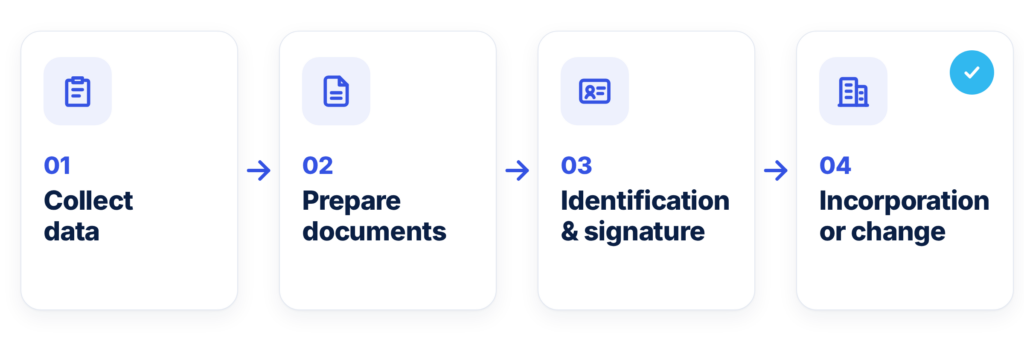
01 · Collect company data in a structured way
A company incorporation starts with information, for example:
- details about the company
- legal form
- registered office
- people involved
In a digital workflow, this data is collected in a structured way and forms the basis for the steps that follow.
This is an important difference from a fragmented process. When information arrives via emails, forms and various documents, it often has to be gathered first and then transferred again for subsequent tasks.
The goal: collect data once in a structured way and make it available for the next steps in the process.
02 · Prepare documents efficiently
Once the relevant company data is available, the required documents can be prepared.
The advantage of a digital workflow is not simply that documents are created or exchanged digitally. What matters is the connection to the previous step: information that has already been collected can be used to prepare the documents, instead of transferring the same details again from emails, forms or other sources for every document.
This simplifies the work, especially for recurring incorporations. The basic process remains repeatable, while the individual requirements of each client matter can still be taken into account.
Structured data becomes prepared documents, without setting up the process from scratch every time.
03 · Integrate identification and signatures
The process is not complete once the documents are prepared. Depending on the case, identification and signatures may be required.
In a modern legal workflow, these steps form part of the existing process. Professional advisers do not have to coordinate them as entirely separate tasks, while clients have greater clarity about when identification or a signature is required.
Personal support remains central. The workflow structures the administrative steps, while the professional adviser manages the client matter and remains available for individual questions or specific requirements.
04 · Move the case forward in a structured way
After data collection, document preparation, identification and signatures, the case can move forward according to the relevant process.
The same principle applies to supported Commercial Register changes, because corporate processes do not end with incorporation. If a company changes its registered office, for example, new information, documents, resolutions, identification or signatures may be required.
Instead of setting up every case from scratch, these tasks can also follow a defined process.
What changes in everyday work?
The difference becomes clear when the two approaches are compared side by side.
| Fragmented process | Digital workflow | |
|---|---|---|
| Data | Gathered from emails and forms | Collected once in a structured way |
| Documents | Details re-entered for each document | Prepared using collected data |
| Identification & signature | Coordinated separately | Integrated into the process |
| Status | Actively followed up | Completed and next steps kept in view |
| Multiple client matters | Cases coordinated individually | Repeatable processes |
For professional advisers, this means less repetitive administrative work. Information and tasks do not need to be brought together repeatedly across different channels, even when several incorporations and changes are being managed in parallel.
The workflow replaces neither professional review nor personal advice. Instead, it provides a structured foundation that allows professional advisers to guide their clients efficiently through the process.
How does Hoop support this workflow?
Hoop supports fiduciaries, law firms, notaries and corporate consultancies in handling company incorporations and supported changes in Switzerland’s cantonal Commercial Registers through this structured process, from data collection and document preparation through to identification and signatures.
The professional adviser remains the central point of contact for the client and retains responsibility for providing advice and reviewing the specific case.
Next steps with Hoop
Incorporate your LLC, Ltd or sole proprietorship directly online with Hoop, including digital identification, qualified electronic signatures and filing with the competent Commercial Register office.
Incorporate a company online with Hoop · Commercial Register offices in Switzerland · Digital share register for LLCs and Ltds
This blog article does not constitute legal advice. It is provided “as is” and makes no claim to completeness or accuracy. Hoop provides no warranty and accepts no liability in relation to its content; to the extent permitted by law, any such warranty and liability are excluded. Use is at your own risk and legal advice should be sought where necessary.